


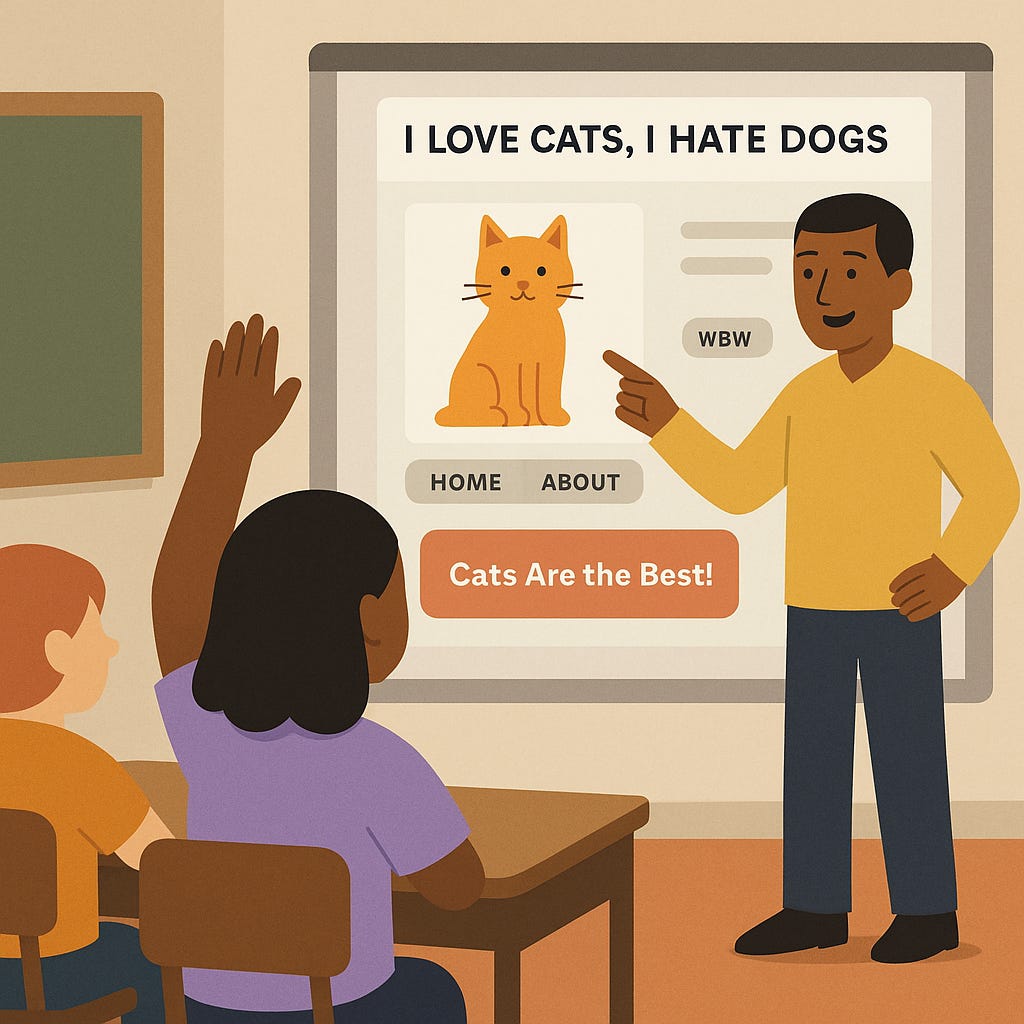
Fabulous Friday at my son Bodhi’s school is a day where parents come to class and share something they are passionate about – think art projects, talking about your profession, teaching yoga, reading a favorite book…you get it.
I brought AI to the classroom.
I wasn’t sure how it would go. These were second graders – seven and eight years old. Would they find it confusing? Intimidating? Or just boring?
They found it magical, and helped me see AI from a new perpsective.
1️⃣ The Story That Wrote Itself
We started simple.
I told them, “Let’s make a story together, ideas?”
Hands shot up everywhere.
“Can it have a dragon?”
“And a donut that talks!”
“Can we make it in space?”
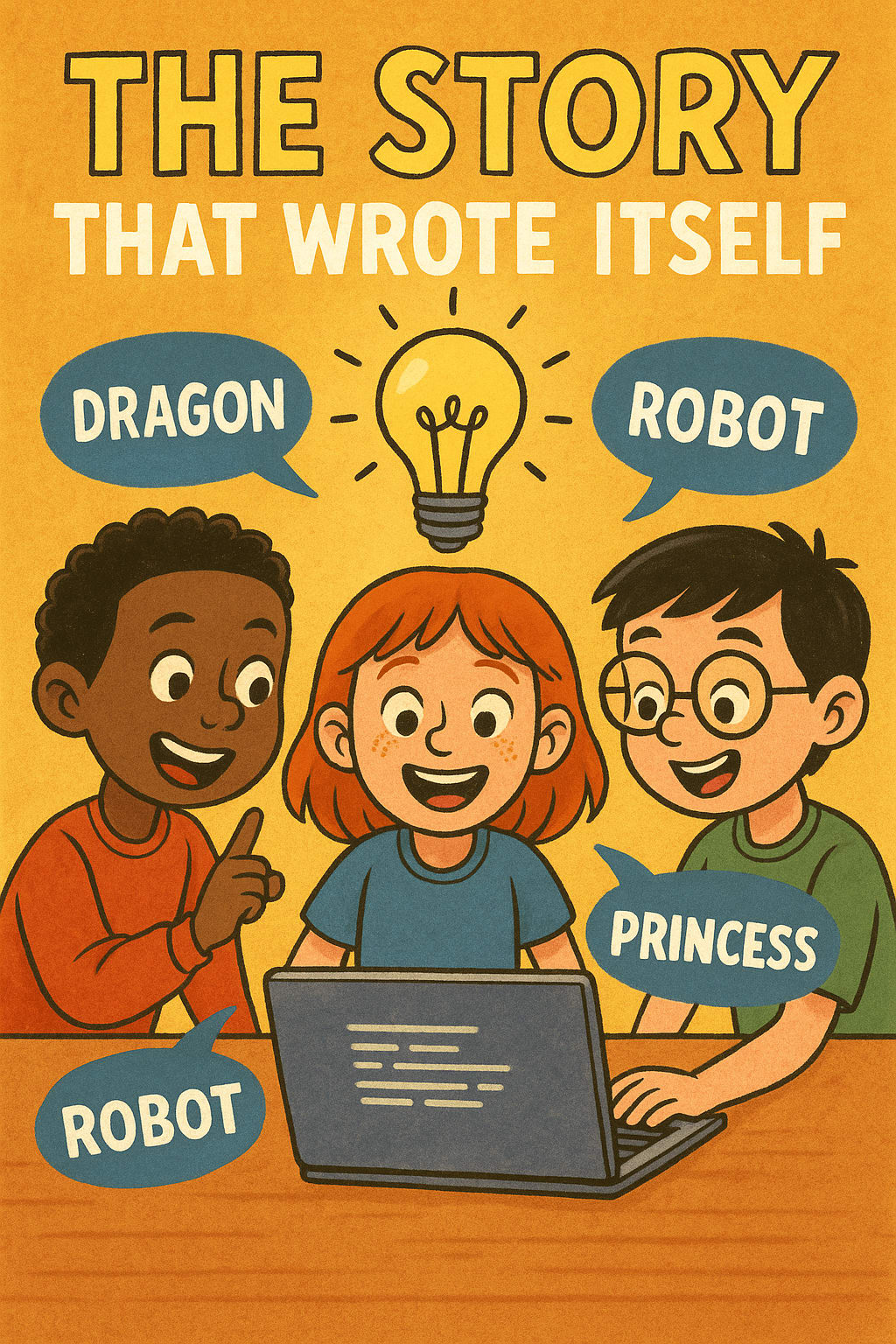
I started typing their ideas into a story generator, one sentence at a time.
Within seconds, we had a wild adventure about a donut-eating dragon who flew to space to save a birthday party. The kids gasped when they saw the paragraphs appear instantly. We read it aloud together, and they cheered when their own ideas appeared in print, and even more when we could add details and characters in an instant.
In that moment, AI wasn’t abstract. It wasn’t “technology.”
It was imagination made visible.
2️⃣ The Shonkey!
Then we tried something sillier.
“Give me two animals!” I said.
They shouted over one another: “Shark!” “Donkey!” “Elephant!” “Unicorn!”
We picked shark and donkey — two creatures that couldn’t be more different — and I typed:
“Create a new animal that’s part shark, part donkey.”
Sixty seconds later, we had a hilarious creature:
A “Shonkey” that could swim underwater, bray bubbles, and eat seaweed carrots.

The class erupted in laughter. We made a few more: a Pigeon-Giraffe and a Tiger-Goldfish.
It was creative chaos, and it was pure joy.
The kids weren’t afraid of the tool; they were guiding it. AI wasn’t replacing their imagination, it was amplifying it.
3️⃣ The Website That Built Itself
Finally, I asked: “Who wants to build a website?”
Every hand went up.
Traditionally, that would mean code, hosting, templates — a project that takes hours or days. But I opened V0 by Vercel, an AI website generator, and asked one student for an idea.
A girl raised her hand and said, confidently:
“I love cats but I hate dogs. That’s my website.”
I typed exactly that in.
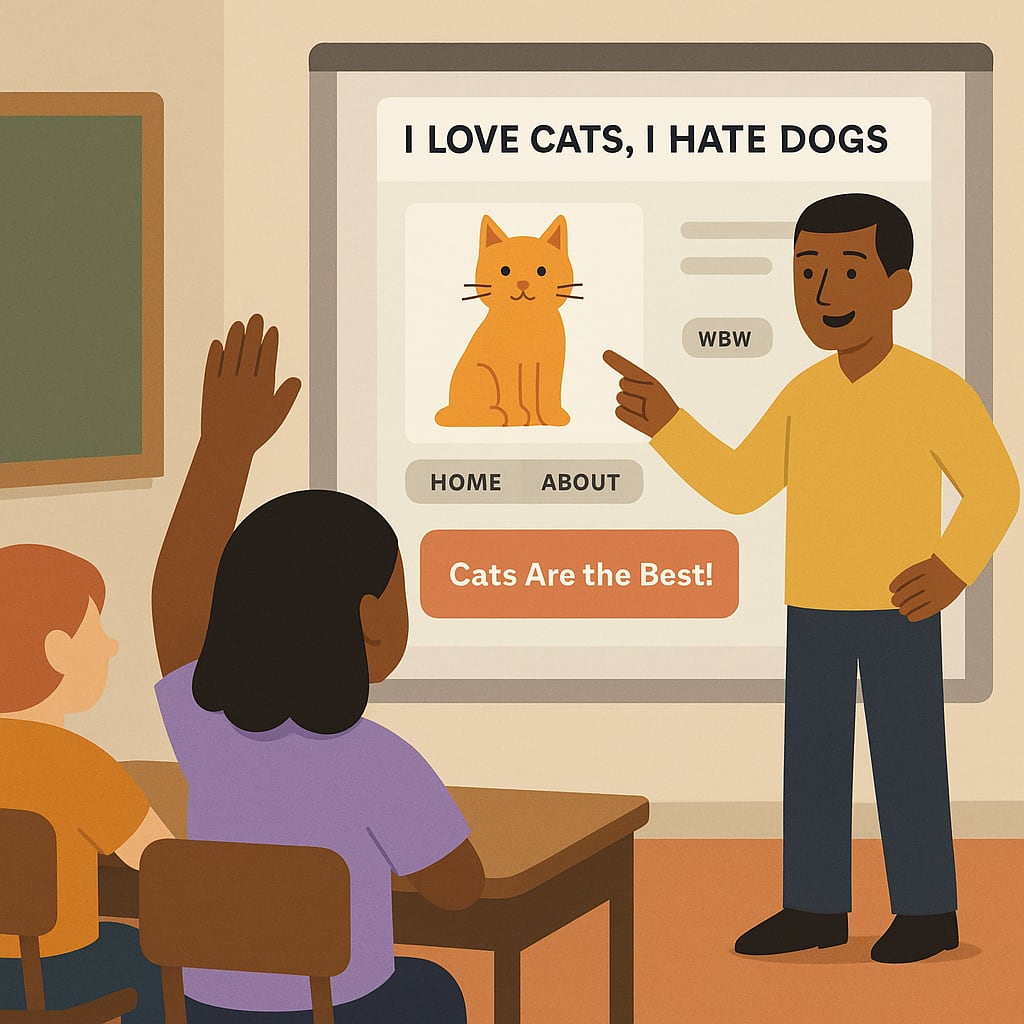
Within ninety seconds, we were staring at a real, working website — filled with cat photos, pink backgrounds, headlines like “Cats Rule, Dogs Drool,” and even links to sections like “Best Cat Breeds.”
The kids screamed, laughed, clapped, and crowded around to see. Their teacher told me that she has never seen her class more interested and engaged in a Fabulous Friday. The hour went by lightning fast, and at the end, I had several students ask me for the links so they could build their own websites and stories at home. Wow….didn’t expect that.
Bodhi, was beaming at my performance, and when he got home that evening, he told me that all his friends loved it and were super curious about AI. He even bragged a bit telling them that his Dad is building an AI app for families.
The Future Is Bright – and Ours to Shape.
I left that classroom feeling amazed, not at what the AI could do, but at how easily the kids gravitated to it and the possibilities it will present in their lives. They didn’t think about algorithms, prompts, or data. They just saw possibility.
They’re not scared of AI. They’re curious. They want to play with it, understand it, and make it their own. They are AI-native.
The leap between “searching on Google” and “talking to AI” doesn’t exist.
For them, typing or speaking to a computer application in natural language isn’t magic – it’s intuitive, it makes sense to them, and they are going to do things with it that we can’t even imagine today.
As parents, educators, and technologists, our role is to guide that curiosity with care.
AI will become part of how our kids learn, create, and communicate – helping them express their imagination in ways we never could. But it’s also up to us to ensure it remains grounded in empathy and responsibility.
We don’t yet know exactly how AI will shape childhood, learning, or identity. But we can already see the outlines of a world where creativity, context, and emotional intelligence matter more than ever. The future is bright – if we build it with care, intention, and a little humility.
AI & the Future of Families
This is a thought space by heyRosie AI, exploring how artificial intelligence will reshape how families live, learn, remember, and connect.
This story I shared above is the beginning of a much bigger conversation; one we hope you’ll join. Over the next several months, we’ll unpack questions like:
-
How will children grow up AI-native? What will that mean for their creativity, safety, and sense of self?
-
How can parents use AI to simplify life without losing presence or privacy?
-
How do we build technologies that help families remember more of what matters, and forget less of what doesn’t?
-
What are the short term and long term realities AI will present to how we live, work, manage our families?
Each post will try to blend possibilities with A, human impact, practical ideas, and hopeful reflection.
If you’re a parent, teacher, or just someone curious about where we are headed with AI and our lives, we’d love for you to subscribe, share your experiences, and comment with your questions and ideas. What excites you about AI and family life? What worries you? What do you want to understand better?
This isn’t just about technology. It’s about raising the first ai native generation and trying to understand what that will be like and how we can shape it for the better!
