


There are moments we think will stay with us forever.
The way your child reached for your hand without looking.
The laugh that filled the kitchen when no one could finish telling the story.
The bedtime question that was somehow funny, profound, and heartbreaking all at once.
The ordinary day that felt forgettable then, but later becomes the season you would give anything to revisit.
And yet, so much of life slips away.
Not because it did not matter.
Because life moves fast, and memory is softer than we want it to be.
That is why memory keeping matters.
Memory keeping is not about being overly sentimental. It is not about turning life into a performance. It is about noticing what matters while it is still here — and giving it a place to live before it fades.
In a world where we document everything but often remember very little, memory keeping has become something deeper than a hobby.
It has become a way of holding onto the meaning of our lives.
What Is Memory Keeping?
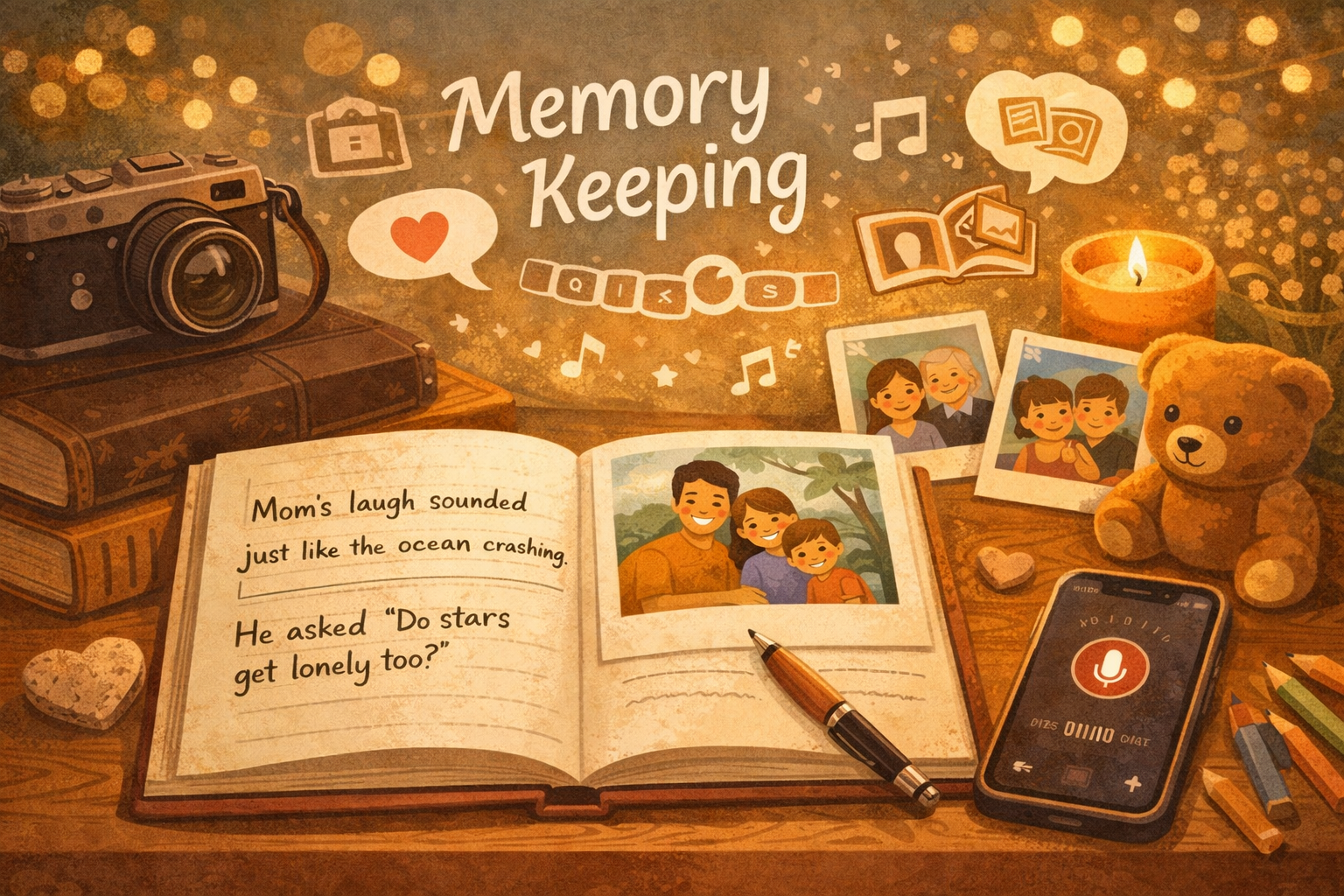
Memory keeping is the practice of preserving meaningful moments, stories, emotions, and experiences so they can be remembered later with context and care.
It can include:
- photos
- journals
- voice notes
- family stories
- milestone memories
- everyday reflections
- keepsakes with written context
- digital memory archives
At its heart, memory keeping is about more than storing information. It is about preserving the story behind the moment.
A photo can show you what happened.
Memory keeping helps you remember why it mattered.
That difference is what makes it so meaningful.
Because memory is not just made of facts. It is made of feeling. It is made of story. It is made of the little details that turn a moment into part of who we are.
Why Memory Keeping Matters
Modern life creates an illusion that everything is safe because everything is saved.
Our phones hold thousands of photos. Our messages keep years of conversations. Our calendars remember where we were. Our cloud storage holds endless fragments of our lives.
But storage is not the same as remembrance.
What many people are really missing is not a place to keep things. It is a way to preserve meaning.
That is what memory keeping offers.
It helps us gather the scattered pieces of life and turn them into something coherent. Something human. Something we can revisit and feel again.
Memory keeping matters because it protects the emotional truth of our lives, not just the evidence that they happened.
It says:
This mattered.
This shaped me.
This is part of our story.
The Benefits of Memory Keeping
There is a reason so many people feel drawn to memory keeping, especially during seasons of change, parenthood, grief, or growth. It gives us a way to stay connected to life as it unfolds.
1. Memory Keeping Helps You Remember More Clearly
Most memories do not vanish instantly. They fade in layers.
First the details soften.
Then the feelings become harder to access.
Then the meaning starts to blur.
Memory keeping helps preserve those layers before they disappear.
Even a short note, a caption under a photo, or a saved voice memo can hold onto a part of life your future self might otherwise lose.
2. It Captures the Ordinary Moments That Become Precious Later
Big milestones are easy to honor. Birthdays, weddings, graduations, vacations — they already feel important while they are happening.
But memory keeping is especially powerful because it protects the smaller moments too.
The breakfast ritual.
The way your child says a certain word.
The dog waiting by the door.
The evening light in your kitchen during a season you did not yet know you would miss.
Often, these are the moments that become most valuable over time.
3. Memory Keeping Adds Context to Photos and Keepsakes
Without context, even meaningful things can become harder to understand later.
You may save the photo but forget the conversation.
You may keep the ticket stub but lose the feeling.
You may remember the event but not why it mattered.
Memory keeping adds that missing layer.
It transforms objects and images into real memories by preserving the emotion and story attached to them.
4. It Supports Reflection and Emotional Connection
Memory keeping helps us slow down enough to notice our lives.
That alone has value.
When you pause to save a moment, you are not just archiving it. You are honoring it. You are giving yourself a chance to reflect on what is happening and why it matters.
This can make life feel fuller, more grounded, and more connected.
5. It Creates Something Meaningful for the Future
At first, memory keeping often feels personal. A private act. A way of holding onto your own life.
But over time, it becomes something more.
It becomes a time capsule for your future self.
A legacy for your children.
A record of family life.
A story that can be passed down.
Memory keeping is one of the quietest ways we say: this life mattered, and I do not want its meaning to disappear.
Memory Keeping for Families
For families, memory keeping has a special kind of weight.
Family life is full of seasons that pass before we fully understand how much they mean. The routines that feel repetitive now become the rhythms you long for later. The cluttered, loud, exhausting years often turn out to be the years filled with the most tenderness.
That is why memory keeping matters so much for parents and families.
It helps preserve:
- funny things kids say
- family traditions
- milestones with emotional context
- everyday routines
- voice recordings from loved ones
- stories from grandparents
- photos that deserve more than a date stamp
Family memory is not built only through major events. It is built through repetition, small details, and shared emotional life.
Memory keeping helps make sure those things are not lost.
Memory Keeping vs Scrapbooking vs Journaling
People sometimes use these terms interchangeably, but they are not exactly the same.
Memory keeping is the broadest category. It includes any intentional practice of preserving meaningful moments and stories.
Scrapbooking is often more visual and design-oriented, focused on arranging photos, paper items, and decorative elements.
Journaling tends to focus on writing, reflection, and inner life.
Memory keeping can include both of those things, but it is not limited to either one.
It can be visual. Written. Spoken. Digital. Simple. Structured. Messy. Elegant.
What matters is not the format.
What matters is the act of preserving meaning.
How to Start Memory Keeping
One of the biggest myths about memory keeping is that you need a perfect system, lots of time, or a naturally organized personality.
You do not.
The best memory keeping practice is the one that fits your real life.
1. Start Small
Do not wait for the perfect notebook, app, or system. Start with one meaningful moment.
Write down something your child said today. Save a photo and add a sentence. Record a quick voice note after a family dinner.
Memory keeping becomes powerful through consistency of care, not perfection of format.
2. Choose a Format You Will Actually Use
Your memory keeping system might be:
- a physical journal
- a digital notes app
- a shared family album
- voice memos
- a photo archive with captions
- an AI-powered memory tool
Choose what feels easy enough to return to.
The best system is the one that reduces friction.
3. Capture Emotional Context
This is the part people most often forget — and the part they are most grateful for later.
Do not just save the moment. Save the feeling.
Instead of writing:
We went to grandma’s house.
You might write:
He ran to her door before I could even unbuckle him. She looked tired, but when she saw him, her whole face changed.
That is memory keeping.
4. Preserve the Small Things
Some of the most powerful memories are not dramatic at all.
Save the little details:
- favorite songs
- inside jokes
- school lunch notes
- bedtime routines
- ordinary conversations
- recurring family phrases
These often become the memories that carry the most emotional weight.
5. Let It Be Imperfect
Some weeks will be fuller than others. Some months you may not capture much at all.
That does not mean your memory keeping has failed.
This is not about completeness.
It is about care.
Even an incomplete record of a meaningful life is still deeply valuable.
What to Include in a Memory Keeping Practice
If you are not sure where to begin, here are a few good places to start.
Everyday Family Life
- funny things your kids say
- morning or bedtime routines
- family dinners
- small habits you love
Milestones and Transitions
- birthdays
- first days of school
- moves
- holidays
- new babies
- changes in family life
Personal Reflections
- what surprised you today
- what felt hard but meaningful
- what you do not want to forget about this season
Stories and Legacy
- memories from your own childhood
- stories from grandparents
- lessons you want to pass on
- values your family lives by
Sensory Details
- favorite songs
- the sound of someone’s laugh
- phrases your family repeats
- how a room felt during a certain season of life
These details often help a memory come alive later.
Digital Memory Keeping in the Modern Age
Today, more people are practicing digital memory keeping than ever before — even if they do not call it that.
They save albums. Record voice notes. Capture short videos. Keep notes on their phones. Store screenshots. Save calendar events. Archive family milestones in group chats or shared folders.
The challenge is not capture.
It is connection.
Digital memory keeping works best when moments are not just stored, but organized in a way that preserves context and makes them retrievable later.
That is where the future of memory keeping is headed.
Not toward more content.
Toward more meaning.
Toward systems that connect photos, stories, voices, dates, people, and emotions into something living. Something searchable. Something that helps people reflect, remember, and pass on what matters.
Why Memory Keeping Matters More in the Age of AI
As technology becomes more embedded in our lives, memory keeping has the chance to become more meaningful, not less.
For years, personal memories have been scattered across devices and apps. But AI can help structure them — connecting moments by people, time, place, theme, and emotional meaning.
That changes what memory keeping can be.
It can become less about manually organizing everything and more about building a living memory system. One that helps you recall not just events, but relationships, feelings, and stories over time.
In that sense, memory keeping is no longer just about preservation.
It is about building continuity.
Identity.
Legacy.
A personal history that remains accessible and alive.
Final Thoughts: Memory Keeping Is a Way of Loving Your Life While You’re Living It
At its core, memory keeping is not really about the past.
It is about attention.
It is about noticing that this season matters before it is gone. It is about honoring the ordinary days that later become the ones you miss most. It is about making sure your life does not disappear into speed, clutter, and digital noise without leaving behind its deeper meaning.
Memory keeping says:
This was worth saving.
This was part of us.
This belonged to our story.
You do not need to capture everything.
But the moments that tug at you — the ones that feel quietly important, the ones you know will mean something later — those are worth keeping.
Because in the end, memory keeping is not about doing more.
It is about forgetting less of what matters most.
FAQs About Memory Keeping
What is memory keeping?
Memory keeping is the practice of preserving meaningful moments, stories, emotions, and experiences so they can be remembered later with context and meaning.
Why is memory keeping important?
Memory keeping helps protect the emotional meaning of your life, preserve family stories, support reflection, and create something valuable for your future self and loved ones.
What are examples of memory keeping?
Examples include journaling, photo captions, voice notes, scrapbooks, digital archives, family story collections, and saving everyday moments with context.
Is memory keeping the same as journaling?
Not exactly. Journaling is one form of memory keeping, but memory keeping can also include photos, recordings, keepsakes, and digital tools.
How do I start memory keeping?
Start small. Choose an easy format, capture one meaningful moment at a time, and focus on preserving feeling and context rather than doing it perfectly.


